

In many industrial projects, system complexity continues to grow. Technical architectures now combine software, electronic, and hardware components that must operate in a coordinated manner while meeting increasingly stringent safety and reliability requirements. For engineers involved in these projects, one challenge frequently arises: how can a complex system be designed while maintaining a clear understanding of its overall behavior and ensuring that functional safety constraints are considered from the very beginning?
For many years, the answer relied primarily on documentation: specifications, functional analyses, architectural descriptions, safety reports, and so on. These documents remain essential, but they can quickly become difficult to keep consistent as projects evolve. Technical teams sometimes find themselves working with information scattered across multiple documents, making it harder to maintain a global understanding of the system and ensure traceability between requirements, functions, and technical solutions. And let’s be honest: if you have ever lost track of the “final” version of a document in an email thread, you know exactly what that feels like—a real obstacle course worthy of a railway maze.
It is in this context that Model-Based Systems Engineering (MBSE) has gradually emerged. The central idea is to rely on a structured system model that becomes the project’s single source of truth. This model provides a consistent representation of requirements, functions, and system architectures while facilitating the understanding of interactions between the various components. In other words: fewer lost sticky notes, more clarity, and fewer caffeine-fueled crises at 5 p.m.
Among the tools that support this approach, Capella has become a major reference in the field of systems engineering. Originally developed by Thales Group, Capella is based on the Arcadia methodology, which provides a structured framework for analyzing and designing complex systems. One of the key benefits of this methodology is its ability to establish a logical progression from user needs to technical solutions while maintaining a coherent view of the entire system.
To illustrate the value of Capella in practice, let us consider a railway signaling modernization project aimed at improving traffic management on a high-density railway line. Before discussing technology, the first question is simple: in what environment will the system operate, and what missions must it fulfill? Operational analysis helps answer these questions. At this stage, the system itself has not yet been defined. Engineers observe the environment and identify stakeholders such as trains, operators, and control centers. In short, they watch the train pass before attempting to build it.
Once this context has been identified, the process moves into the “black box” phase. The system must satisfy the identified needs, but how it will do so is not yet considered. The focus is on defining the main functions and interactions with the environment. The black box is then gradually opened through logical architecture, which decomposes the system into components and shows how they cooperate to perform the expected functions. Finally, the process reaches the physical architecture stage, where logical components are translated into actual technical elements: computers, embedded software, and trackside equipment.
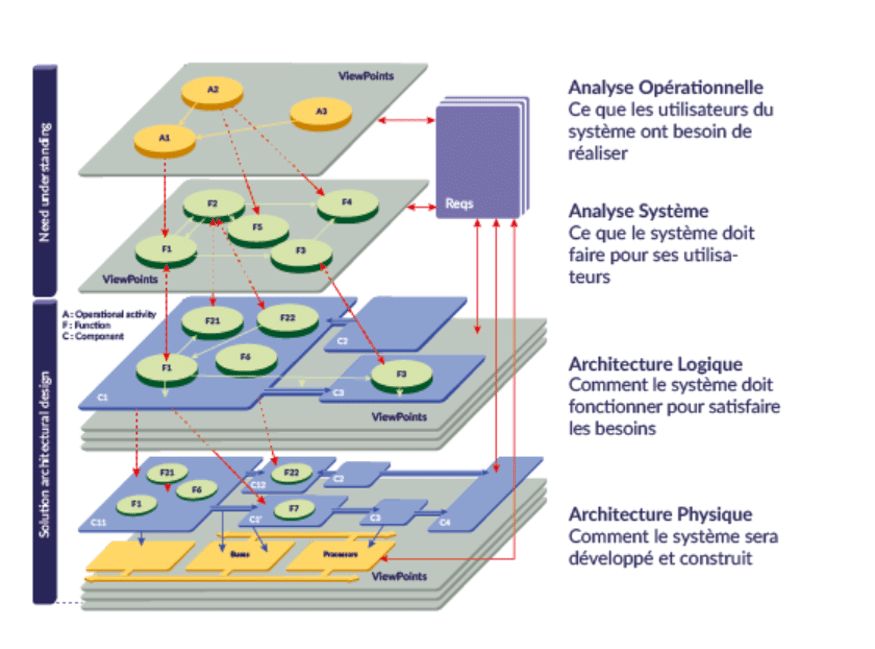
One of Capella’s greatest strengths is the traceability it provides between requirements, functions, and components. In railway projects, where functional safety is critical, this traceability makes it easier to identify critical functions, dependencies, and sensitive interfaces, thereby supporting risk analyses and validation activities. The model becomes a valuable asset for safety engineers, who can visualize which functions are linked to safety requirements and verify that they are properly implemented.
Another advantage frequently appreciated by project teams is improved collaboration. When multiple disciplines work together on a complex project, a shared model helps avoid misunderstandings and duplicate work. And if a software engineer and an operations specialist happen to disagree about an interface, a visual model is often the best way to bring everyone back onto the same page.
To further illustrate Capella’s effectiveness, consider a simplified railway case study involving a CBTC (Communication-Based Train Control) signaling system on a heavily used urban line. Before Capella, each team worked with its own set of documents, sometimes leading to inconsistencies in critical functions. By using Capella, engineers were able to model the operational context, key functions, and logical and physical architectures within a single model. The result was a better overall understanding of the system, guaranteed traceability, and earlier identification of risks. Functional safety considerations were integrated from the earliest project phases, reducing costly design changes later in the lifecycle. As an added bonus, everyone could finally explain the project without relying on 10,999 different acronyms.
Ultimately, the relationship between systems engineering and functional safety becomes clear: structuring the architecture enables a better understanding of the system, and that understanding forms the foundation of any safety analysis. Capella is therefore much more than a modeling tool—it is a powerful lever for improving control of complex railway systems, anticipating risks, and enhancing overall safety.
To conclude on a lighter yet thoughtful note, as physicist Niels Bohr famously said: “Prediction is very difficult, especially if it’s about the future.” With Capella, at least, engineers can predict critical interactions before the real system starts running on the tracks.